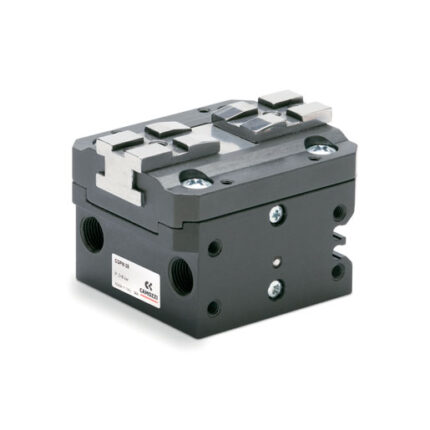
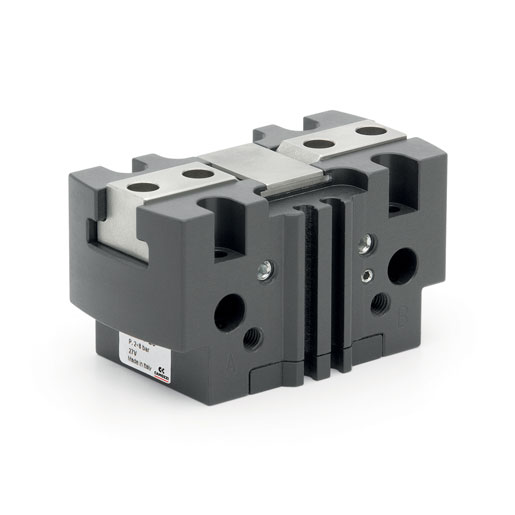
Parallel grippers with T-guide Series CGPT

Single and double acting, magnetic, self-centering
Sizes: ø16, 20, 25, 32, 40, 50, 63, 80 mm
Thanks to the use of a high performing and precise force transmission system, the Series CGPT grippers are able to provide high gripping forces while guaranteeing a very high repeatability.

The wide range of sizes available allows you to find the best solution for any need of movement. The grippers are supplied with centering bushes (tolerance H8) which, once positioned on the body and/or on the jaws, are able to guarantee, during maintenance, a high interchangeability of the gripper and of the extensions.

General Data

Type of constructionSelf-centering parallel gripper with T-guide
OperationSingle acting (NO, NC), double acting
SizesØ16, 20, 25, 32, 40, 50, 63, 80 mm
Force transmissionLever
Air connectionsM3 (Ø16), M5 (Ø20, 25, 32), G1/8 (Ø40, 50, 63, 80)
Working pressure2 ÷ 8 bar (double acting), 4 ÷ 8 bar (single acting)
Working temperature5°C ÷ 60°C (standard) – 5°C ÷ 130°C (high temperature version)
Store temperature-10°C ÷ 80°C
Max. use frequency3 Hz (ø 16, 20, 25, 32), 2 Hz (ø 40, 50, 63, 80)
Repeatability [% FS]0.02 mm
Interchangeability0.1 mm
MediumFiltered air in class 7.4.4 according to ISO 8573-1. In case lubricated air is used, we recommend ISOVG32 oil and to never interrupt lubrication.
LubricationAfter 10 million cycles, grease the sliding zones using Molykote DX grease.
Protection classIP 40
CompatibilityROHS Directive
CertificationsATEX (II 2GD c IIC 120°C(T4)-20°C≤Ta≤80)
MaterialsPTFE, Silicone and Copper free

N.B. Pressurize the pneumatic system gradually in order to avoid uncontrolled movements

Coding Example

CGPT16NCWEX
CGPTSERIES
16SIZES
16
20
25
32
40
50
63
80
NCFUNCTIONING
= double acting
NO = single acting, normally open
NC = single acting, normally closed
PNEUMATIC SYMBOLS
PNZ1
PNZ3
PNZ2
WVERSION
= standard
W = high temperatures (130 °C) – not magnetic
EXAdd EX to order the certified ATEX version

Download

– REACH-Series-CGPT.pdf
– RoHS-Series-CGPT.pdf